

Paint Data Sheet Terms: A Practical Reading Guide
In this article, we will explain some of the technical terms found in paint datasheets. Understanding these concepts will not only help you better understand the datasheet data, but will also help you select the right product and apply the paint correctly.
1-Appearance classification of drying surfaces
1.1 Surface drying
Surface dry, touch dry and cured for service are different stages. Check the test definition in the selected product data sheet; a dry-looking surface alone does not establish readiness for overcoating or immersion.
2.1 Touch dry
In a common data sheet definition, light finger pressure leaves no imprint or tackiness. Use the manufacturer’s stated test and conditions.
3.1 Dry to handle
It is when the paint film has hardened enough that it can be carefully picked up and carried.
4.1 Dry to overcoat
It is the time after which the next coat of paint can be applied to the surface without the layers mixing together.
Drying and overcoating depend on substrate temperature, film thickness, ventilation, humidity and the product. Read the reference temperature and both minimum and maximum overcoating intervals. Where the maximum interval is exceeded or contamination occurs, follow the specified cleaning and surface preparation procedure.
5.1 Complete hardening
Cured for service means the coating has reached the condition specified for its intended exposure. The time may change with temperature, but a rule that halves cure time for each 10°C rise does not replace the product table. Immersion, chemical service and foot traffic may require different waiting periods.
2- Some definitions and parameters specific to color
1.2 Gloss of the final film
The appearance and gloss of the paint film are divided into the following five categories. These data are collected for the dry paint film and a light incidence angle of 60 degrees (in accordance with ASTM D523).
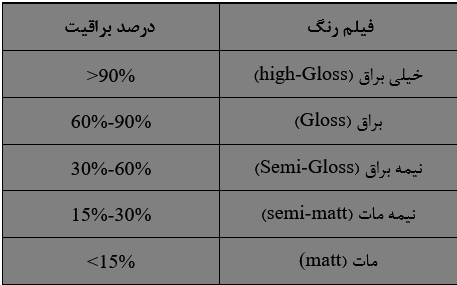
Classification of paint films based on gloss
2.2 Wet film thickness
The thickness of the paint film immediately after application to the surface is called the wet film thickness. There are operational methods for measuring the wet paint film, which are mentioned in the literature related to paint application inspection.
2.3 Dry film thickness
After the paint has completely dried, only a portion of the original volume of paint applied remains on the surface. Dry film thickness is the thickness of the remaining coating film after drying, normally expressed in micrometres. Methods for measuring this parameter are described in the section on paint application inspection.
2.4 Volume solids and mass solids
This parameter is defined as volumetric solids and mass solids and represents the percentage by volume (mass) of paint that remains on the surface after drying. Volumetric solids are calculated according to the following equation:

In this case, VS% represents the volume solids percentage.
Paints can also be classified into four categories based on their volume solids content as follows:
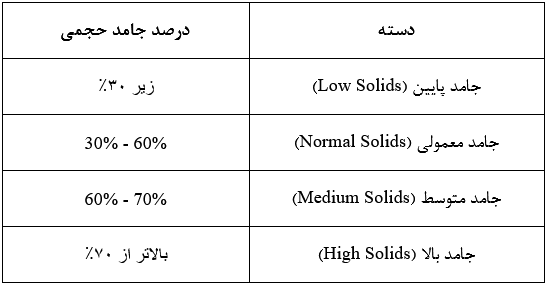
Color classification based on volume solids percentage
3- Density and specific gravity
Density is mass per unit volume, expressed for example in g/cm³ or kg/L. Specific gravity is a ratio to a reference density and has no unit. Do not confuse these terms when converting kilograms to litres.
For two-component paints, check whether the value describes the base, hardener or mixed product. Read the test temperature and units. Mixing ratios by weight and by volume are not necessarily equal.
4- Volatile organic matter content
This parameter expresses the amount of volatile organic compounds in the paint per liter of paint. Also in English units, this quantity is expressed in terms of the amount of volatile organic compounds in pounds per gallon.
5- Shelf life
This parameter is of great importance in paint storage and is the length of time that the paint can be stored in optimal storage conditions. Use the selected product’s stated shelf life and storage temperature range. A universal one-year limit or fixed storage temperature range is not valid for every coating. Keep containers closed and stored as specified by the manufacturer. If the paint is stored in inappropriate conditions, the properties of the paint content may be lost before the expiration date and it cannot be applied. This problem is usually observed in the form of gelling, clumping or the formation of a thick layer of dry paint film.
For more information, read the article “Safety Principles in the Storage and Use of Paint” on this website.
For specialized advice and purchase of marine, coastal, offshore, industrial, and construction paints from Kansai, contact Armanifam.
Data sheet reading checklist
- Confirm the exact product, grade, document revision and date.
- Check thickness units, volume solids, mixing ratio and reference temperature.
- Read minimum and maximum overcoating intervals separately from readiness for service.
- Use the technical data sheet together with the safety data sheet and application guide.
For help selecting a coating system, contact Armani Fam.
Example reference: official Jotun Alkyd Topcoat data sheet. Its numerical values must not be applied to other products.
